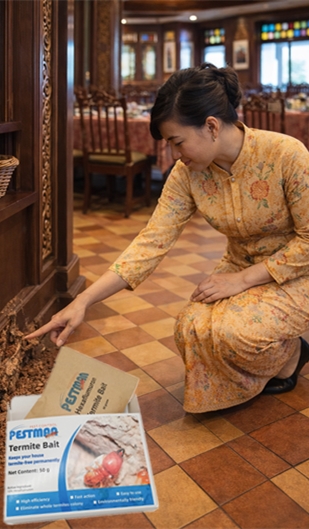
Pattaya, Thailand — In luxury hospitality, perfection is often measured by what guests never see. At Emerald Bay Resort, a high-end beachfront retreat in Pattaya, a few faint lines of mud at the edge of a swimming pool nearly shattered that illusion — and exposed how a small decision can quietly escalate into a major crisis.
What followed became a case study in the risks of do-it-yourself pest control, and how a targeted baiting strategy helped save both a building and a brand.
A Routine Check and an Easy-to-Miss Warning
The first sign appeared on an otherwise ordinary afternoon. During a scheduled inspection, the resort’s housekeeping manager walked past a private pool reserved for VIP guests. At the base of a wooden pavilion — a shaded structure used for lounging and afternoon tea — something caught her eye.
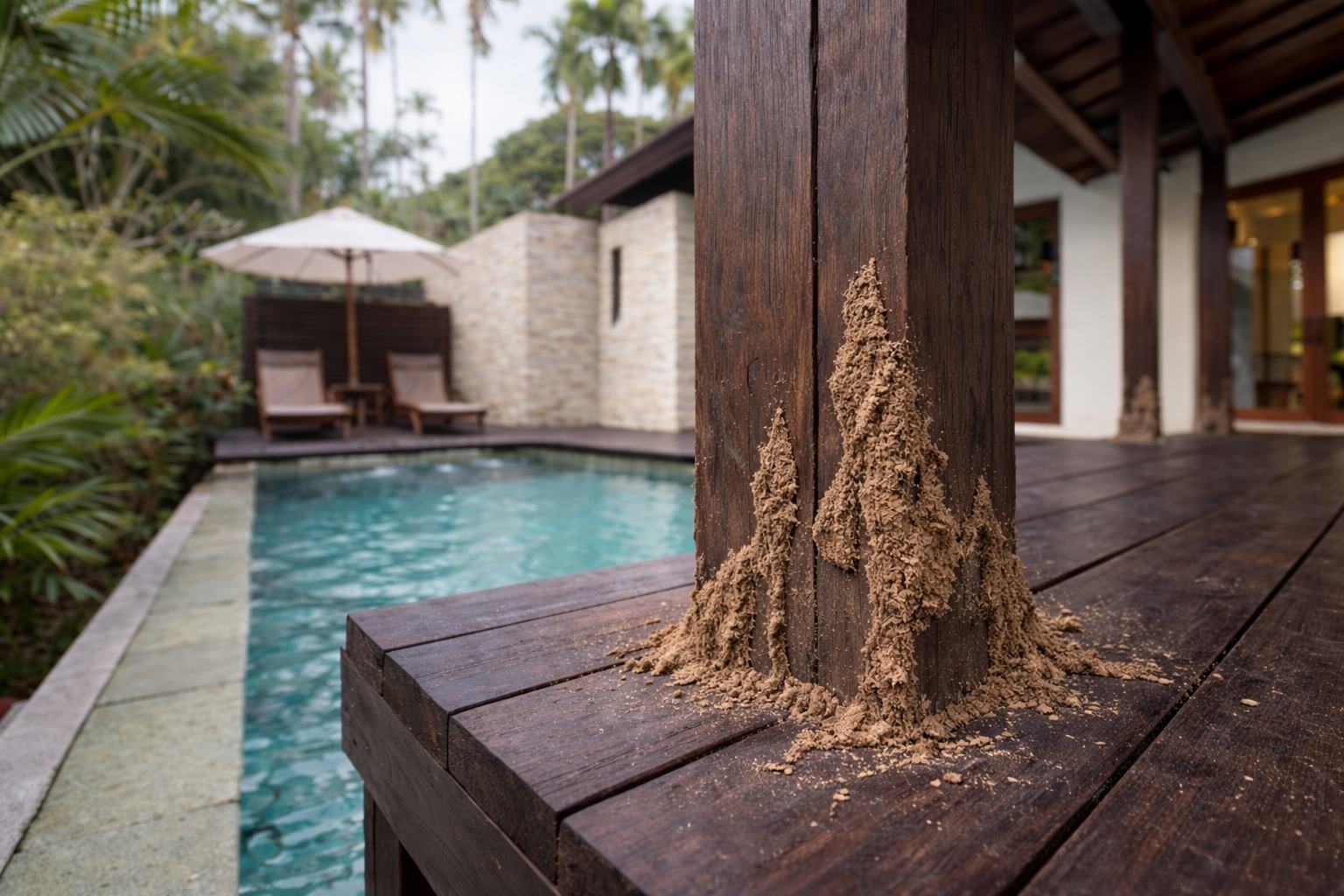
Thin brown lines, no wider than a matchstick, crept upward from the soil onto the timber pillar.
To an untrained observer, they looked like dried dirt or water stains left by recent rain. In fact, they were termite shelter tubes — protective mud tunnels built by subterranean termites to move safely between soil and wood.
The discovery raised a dilemma. Reporting a possible termite issue could trigger inspections, internal reviews and concern at head office. The manager chose a quicker route.
A can of insect spray was purchased from a nearby market. The visible mud lines were sprayed thoroughly.
Within hours, the insects disappeared. The tunnels dried out. The area looked clean again.
The incident was not logged.
The Calm Before the Spread
For several weeks, nothing seemed wrong. Guests continued to enjoy the poolside pavilions. Rooms remained fully booked. No further signs were reported.
But beneath the surface, the colony had not been destroyed.
Disturbed by the chemical spray, the termites had retreated deeper into the structure. Instead of feeding openly, they began expanding their network — creating new galleries inside wall cavities, behind wardrobes and beneath wooden flooring.
By the time the next signs appeared, the problem had grown far beyond the pool.

When the Problem Reappeared — Everywhere
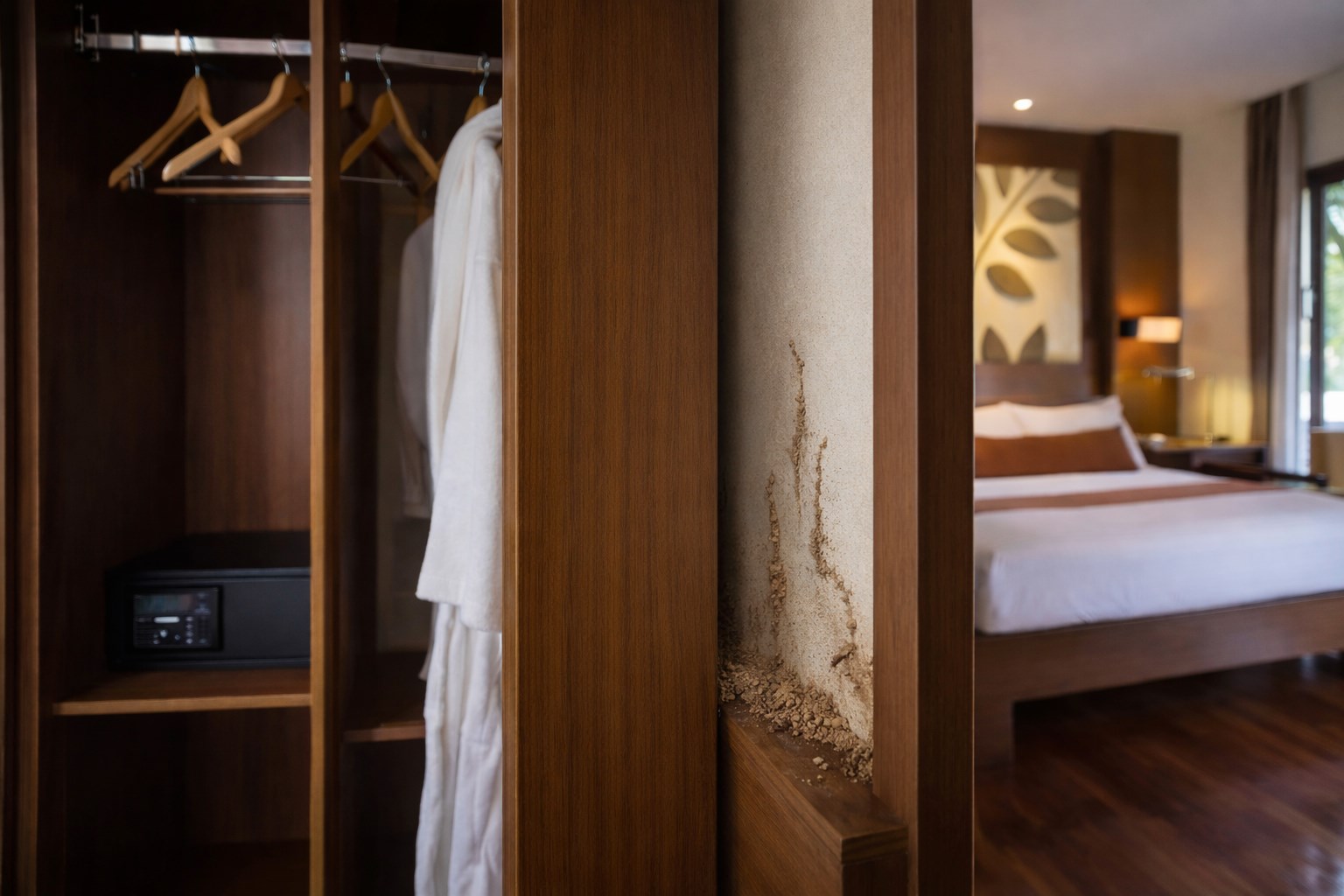
One month later, housekeeping staff noticed fresh mud tubes along the skirting board of the same guest room near the pool. Shortly after, similar markings appeared in the adjoining room.
Maintenance workers were called in. When they tapped on a wooden wardrobe panel, the sound was hollow.
In another suite, a decorative timber wall panel emitted the same echo. The wood looked intact on the surface, but something inside was wrong.
The termites had spread.
What began as a single, localised colony had fragmented into multiple feeding points inside the building — a common response when termites are disturbed but not eliminated.
A Guest’s Discovery Triggers Public Alarm
The crisis became impossible to contain when a long-term guest made a disturbing discovery.
Inside a wardrobe, she found small piles of discarded insect wings — a sign of termite swarming. Later that day, she spotted live termites crawling near the edge of the bathroom floor.
Shaken, she took photos and posted them on social media and a hotel booking platform.
The headline was blunt:
“Sleeping with termites in a five-star hotel?”
The post spread quickly. Other guests began asking questions. Front desk staff fielded calls about cancellations. The resort’s online rating dipped within hours.
For a brand built on calm, privacy and flawless presentation, the damage was immediate.
Management Steps In
Senior management launched an internal review and quickly traced the issue back to the initial poolside discovery — and the decision to handle it internally.
The affected rooms were taken out of service. Access to the poolside pavilion was restricted. The general manager authorised an emergency call to Thai Green Shield, one of the most experienced pest control companies in the region.
The message was clear: the problem had to be solved quickly, quietly and completely.
Diagnosing the Real Enemy
Thai Green Shield’s technicians arrived with specialised equipment. Using acoustic detectors, moisture meters and fibre-optic cameras, they inspected the pool structures, guest rooms and surrounding soil.
Within hours, they confirmed the culprit: Coptotermes, a highly aggressive subterranean termite species known for attacking hardwood and spreading rapidly through buildings.
The main nest was believed to be beneath the poolside wooden structures, where moisture, shade and soil contact created ideal conditions. From there, secondary colonies had extended into guest room walls and furniture.
The technicians explained that the earlier insect spray had killed only exposed worker termites. More importantly, it had triggered a defensive response — forcing the colony to split and relocate.
“This is how small problems become big ones,” one technician noted.
Why Sprays Fail — and Bait Works
Traditional sprays, the team explained, act on contact. They do not reach the queen or the core of the colony, which may be metres away underground.
In contrast, a baiting system relies on termite behaviour itself.
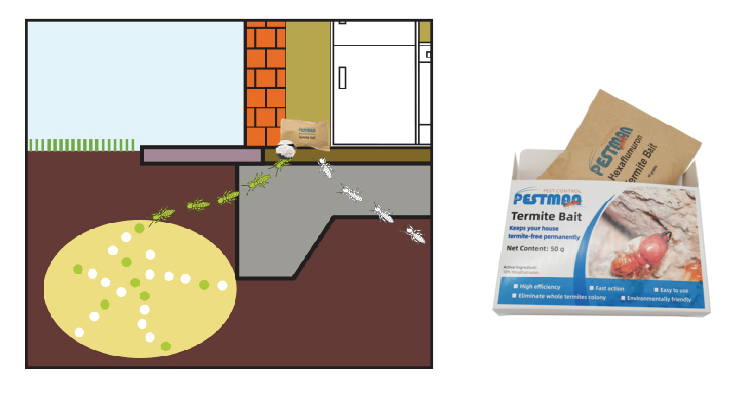
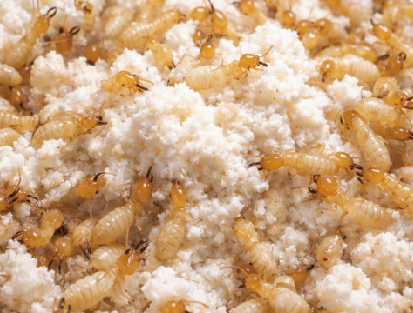
Worker termites feed on the bait and carry it back to the nest, sharing it with other workers, soldiers, larvae and eventually the queen through natural feeding processes. Over time, the colony collapses from within.
For this project, Thai Green Shield recommended a monitoring-and-baiting programme using Pestman Termite Bait, designed to eliminate the colony without disturbing hotel operations.
Careful Placement, Measured Response
Rather than blanket treatments or fumigation — which would have required evacuating rooms and potentially damaging wooden structures — the team opted for targeted placement.
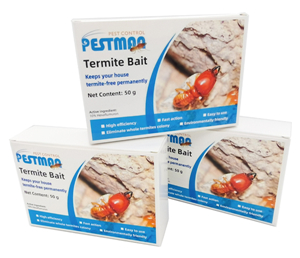
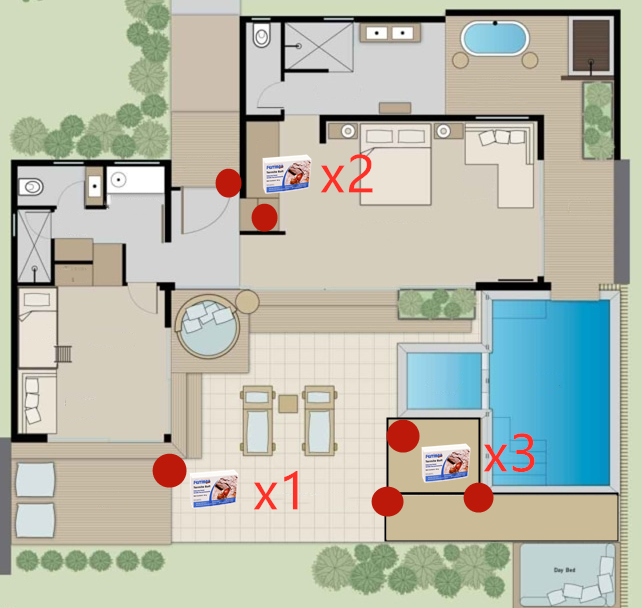
A total of six packs of Pestman Termite Bait (50 grams each pack) were used:
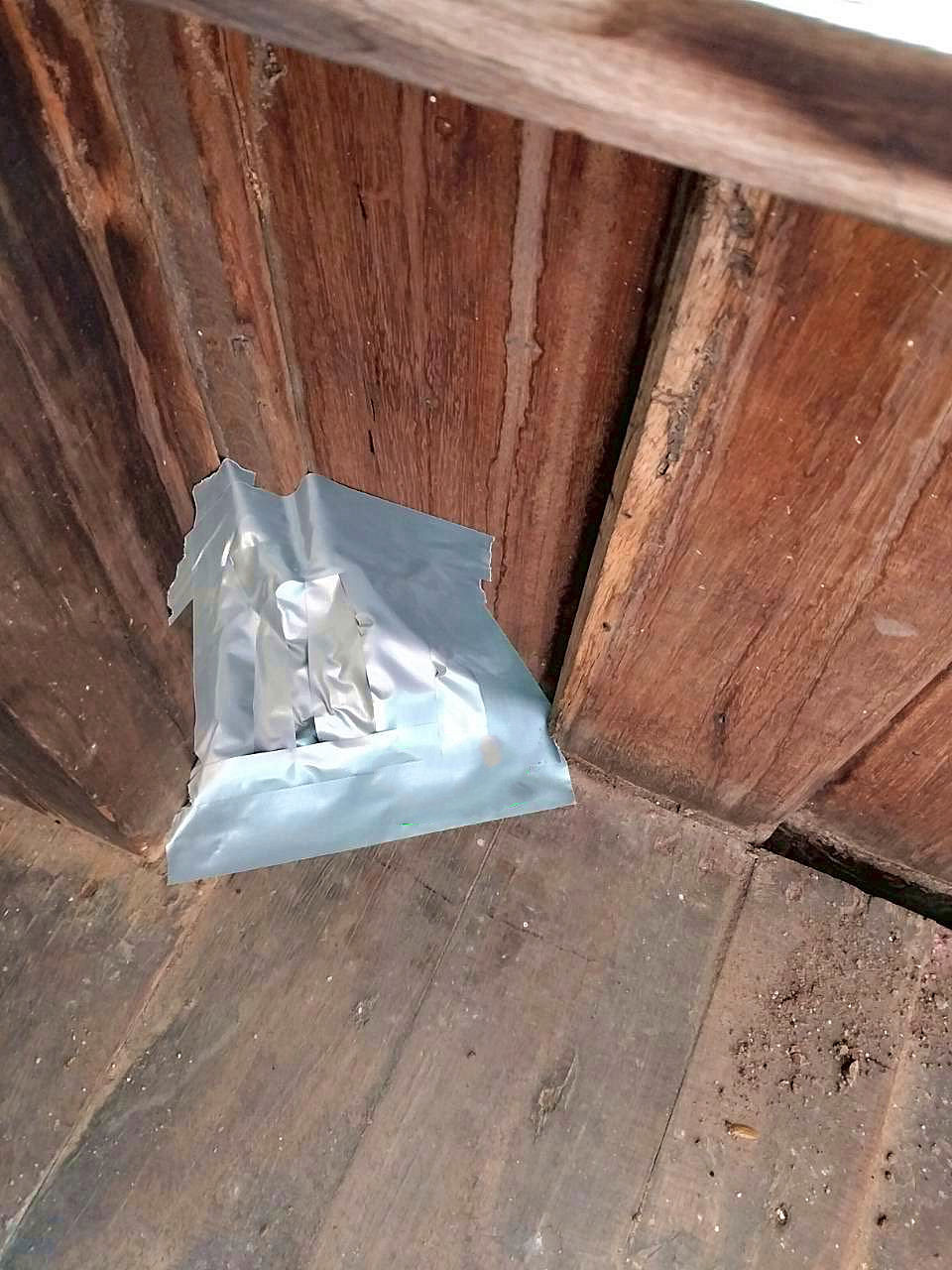
Three packs were installed at the base of the poolside wooden pavilion pillars, directly at the soil-wood interface where termite activity was strongest.
Two packs were inserted behind built-in wardrobes in two guest rooms, accessed through discreet drill points into active galleries.
One pack was placed beneath a timber deck near the pool’s lounge area, where early signs of feeding were detected.
Under normal conditions, technicians explained, one to three packs are often sufficient to eliminate a single colony. However, the resort requested faster results to reduce operational risk.
Using six packs allowed the active ingredient to circulate through the termite population more quickly.
Watching the Colony Collapse
Monitoring began immediately.
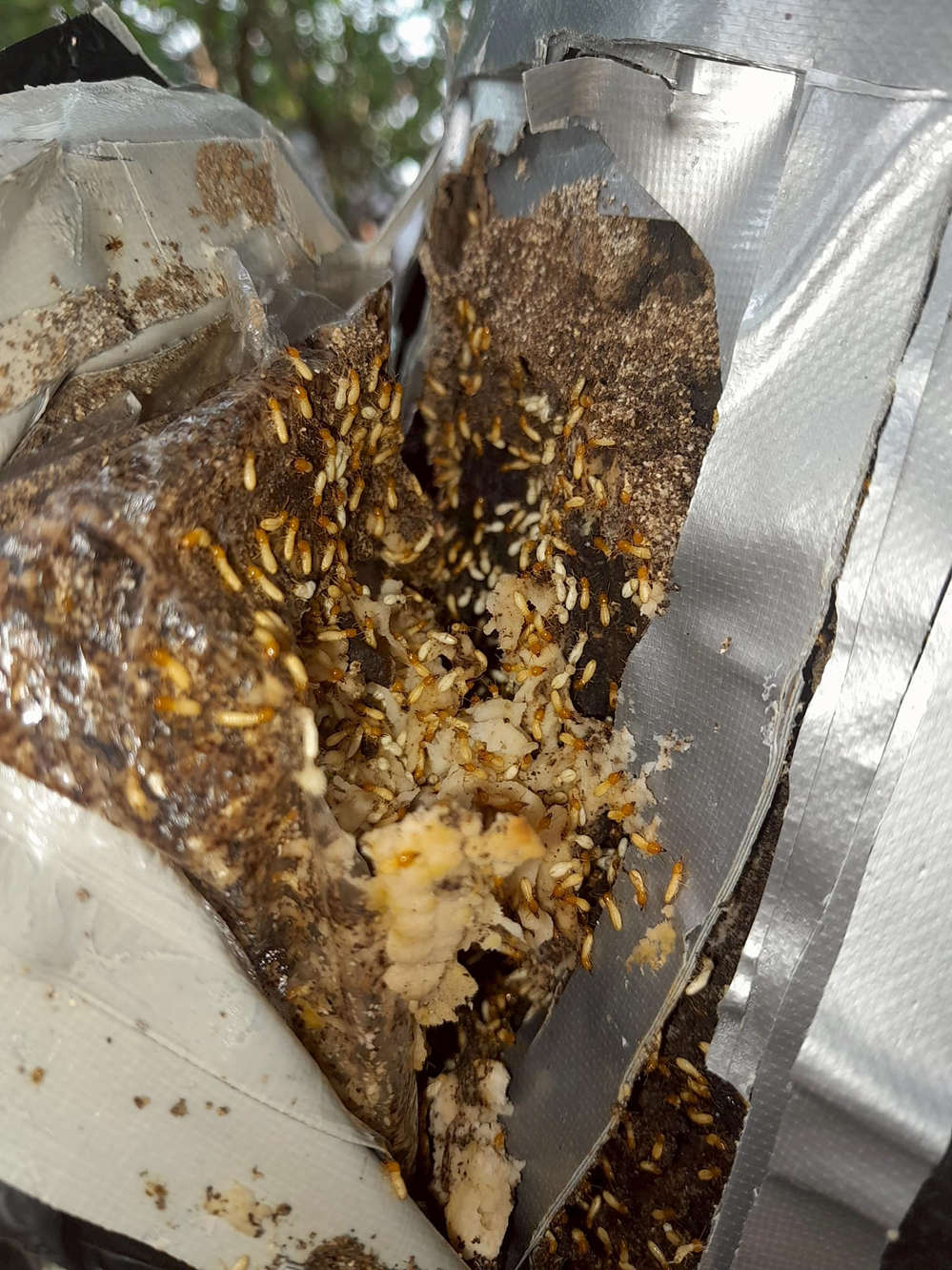
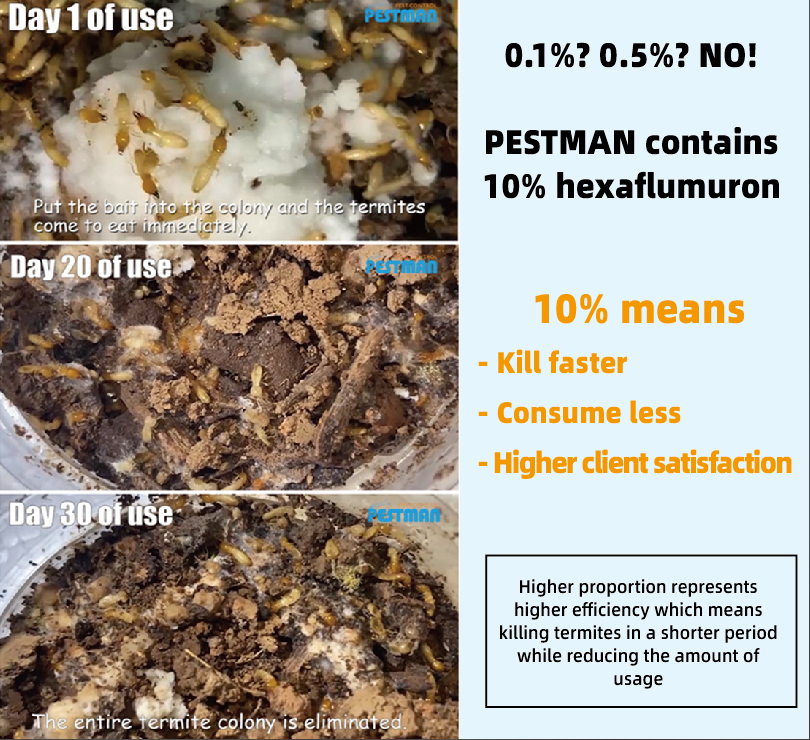
Within the first week, technicians observed heavy bait consumption. By the second week, visible termite activity had dropped sharply.
After four weeks, the main feeding tunnels were inactive. By weeks six to eight, all monitoring stations showed no signs of live termites.
The colony was declared eradicated.

Quiet Recovery, Lasting Impact
Two months of follow-up inspections confirmed the result. No new termite activity was found anywhere on the property.
Only small sections of damaged wood required repair. There was no need for major renovations or prolonged room closures.
The general manager later reflected on the experience:
“We almost created a bigger disaster by trying to save time. The solution worked quietly, without disruption — exactly what a hotel needs.”
Compared with traditional methods, the resort estimated total costs were around 40% lower, largely due to avoided downtime and minimal structural repairs.
Emerald Bay Resort has since banned all non-professional pest treatments and signed a long-term monitoring agreement with Thai Green Shield.
More Than Pest Control
For the resort, Pestman Termite Bait proved to be more than a technical solution. It became a safeguard for the hotel’s physical assets, its reputation and, ultimately, guest trust.
The lesson, management says, is clear: when termites appear, what matters most is not speed — but strategy.
—————————————————————————————————
Indoor Termite Treatment Methods
We Recommend Pestman Termite Bait for indoor termite control
No Need for Detection Devices: The bait itself is a monitoring tool.
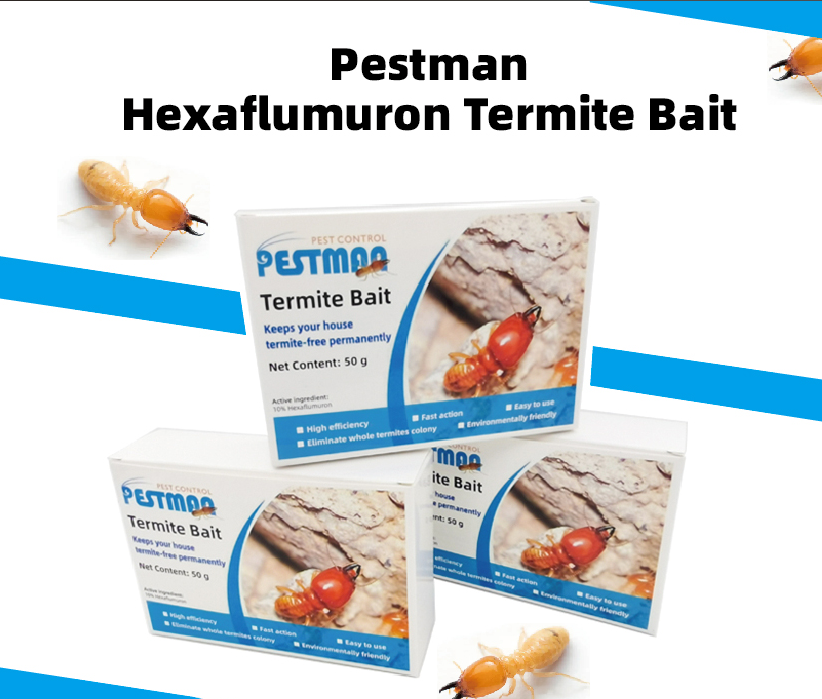
Pestman Hexaflumuron Termite Bait can effectively control and eliminate termites, particularly in wooden structures, by attracting termites to feed on the bait. Pestman Termite Bait is formulated with 10% hexaflumuron, lignocellulose, pheromones and other attractants, which disrupts the termites’ molting process. Once consumed, the bait carries the slow-acting toxic substance that is shared with the entire termite colony, ultimately resulting in the destruction of the entire colony. This method relies on the termites’ natural behavior to spread the poison throughout their social structure, leading to colony-wide elimination. Once termites begin feeding on the bait, they stop feeding on the wood in the building.
Key Components:
Hexaflumuron:
What It Is: Hexaflumuron is a chemical compound primarily used as an insecticide, especially in the control of termites.
Why It’s Important: It works by inhibiting chitin synthesis. Chitin is essential for the termite exoskeleton, and termites need to synthesize it during growth and molting. Hexaflumuron interferes with this process, disrupting termite growth and development, and ultimately leading to their death.
Cellulose (Wood-Based Material):
What It Is: Cellulose is the primary food source for termites, derived from wood or plant materials.
Why It’s Important: Termites are naturally attracted to cellulose, making it the perfect base for bait. It ensures that termites will feed on the bait and carry it back to the colony.
Tracking Pheromones:
What It Is: Tracking pheromones mimic the natural trails termites use to navigate.
Why It’s Important: Tracking pheromones guide termites to the bait station, increasing the likelihood that the bait will be found and eaten.
Aggregation Pheromones:
What It Is: Aggregation pheromones signal to other termites that a food source has been found.
Why It’s Important: They encourage more termites to gather at the bait station, ensuring a higher intake of the bait and faster colony elimination.
Advantages:
– Powerful Killing Effect: Eliminates the queen and the entire colony.
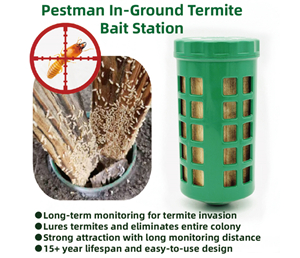
– Flexible Application: Can be used directly or with in-ground and above-ground bait stations.
– Reduced Chemical Exposure: Safe for humans, pets, and the environment. Unlike traditional methods that involve spraying chemicals across a large area, termite bait is healthier for customers.
– Effective Against All Termites: Works on Coptotermes, Reticulitermes, Odontotermes, Macrotermes, and more.
– Versatility for Different Structures: Suitable for various types of buildings, including residential homes, commercial properties, and structures with wooden components.
True professionalism lies not in the number of tools you have but in understanding the behavior of termites—and precisely placed bait is your best tool.
Value for pest control companies:
– Long-Term Protection: Provide long-term protection by eliminating entire colonies, thereby preventing future infestations from the same colony.
– Customer Satisfaction: The effectiveness and safety of baiting systems can lead to higher customer satisfaction and trust.
– Cost Savings: Highly concentrated, requiring only 50g-150g to effectively eliminate a termite colony, making it a cost-efficient solution.
– No Special Skills Required: Simple enough for junior staff to handle installation and observe the results of colony elimination.
– Non-Invasive: Unlike traditional liquid treatments, termite bait are less invasive and do not require extensive drilling or excavation, preserving the structural integrity of the treated properties.
– Differentiation: Offering advanced baiting technology can differentiate a pest control company from competitors, showcasing their commitment to using the latest and most effective methods.
– Enhanced Reputation: Adopting Pestman termite bait shows pest control companies’ commitment to environmentally responsible practices, ensuring regulatory compliance and appealing to eco-conscious consumers.
Why Choose Pestman?
As a pest control company, you need to provide clients with efficient, safe, and reliable termite control solutions. By choosing Pestman, you will gain access to industry-leading termite control products like Pestman Termite Bait, which uses advanced formulations to precisely attract and eliminate termites, ensuring long-term protection. Pestman also offers comprehensive technical support and training to help you enhance service quality and build client trust. We provide logistics support for the Philippines, Indonesia, Vietnam, Cambodia, Singapore, Malaysia, Thailand, and other regions, with door-to-door delivery. Contact us today, and let’s cooperate to help more clients effectively solve their termite problems!
WhatsApp: +8618958096066
You can also reach us through the chat window in the lower-right corner of our website.