How to Identify a Reliable Cockroach Gel Bait Manufacturer
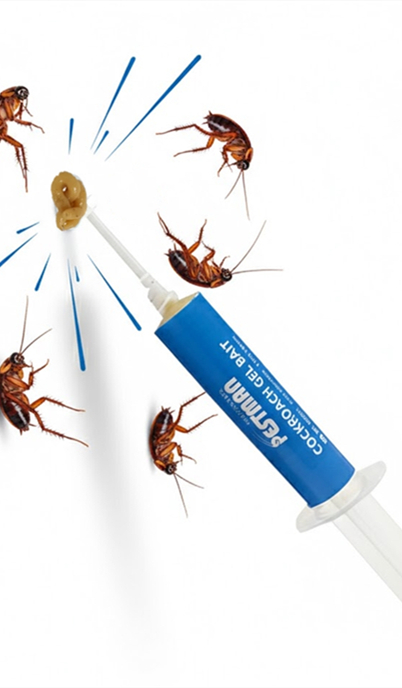
Cockroach infestations are a serious problem in homes, restaurants, hotels, and commercial buildings worldwide. As demand for effective pest control products continues to grow, cockroach gel bait has become one of the most widely used solutions in the pest management industry.
For Distributors, Wholesalers, Online Seller, Retailers, and Pest Control Companies, choosing a reliable cockroach gel bait manufacturer is crucial. A high-quality product can ensure strong customer satisfaction, repeat purchases, and long-term business success.
However, with many suppliers on the market, how can buyers identify the right manufacturer?
In this guide, we will explain the key factors to consider when selecting a cockroach gel bait supplier.
Cockroach infestations are a major sanitation issue in residential, commercial, and industrial environments. Businesses such as restaurants, hotels, supermarkets, and food processing facilities rely on professional pest control solutions to maintain hygiene standards.
Among modern pest control technologies, cockroach gel bait has become one of the most effective solutions due to its ability to eliminate entire cockroach colonies.
Unlike traditional insecticide sprays that kill insects on contact, cockroach bait works through behavioral transfer mechanisms. Cockroaches are attracted to bait, consume the toxicant, and subsequently transfer the poison to other members of the colony.
Scientific descriptions of cockroach bait formulations explain that they combine attractants with insecticides, allowing cockroaches to ingest poison and spread it through colony interactions.
For Distributors, Wholesalers, Online Seller, Retailers, and Pest Control Companies, choosing the right cockroach gel bait manufacturer is therefore a critical business decision.
However, the global pest control supply chain contains a wide range of suppliers with very different levels of technical expertise and manufacturing standards.
This guide provides a scientific procurement framework for identifying reliable cockroach gel bait manufacturers.
Global Cockroach Control Market Overview
Industry data
The global pest control industry continues to expand due to increasing urbanization, stricter hygiene regulations, and growing awareness of disease prevention.
Industry research suggests:
The global pest control market exceeds $20 billion annually.
Urban pest management accounts for a large portion of industry demand.
Cockroach infestations remain one of the top three urban pest issues worldwide.
Commercial environments with high cockroach risk include:
restaurants
hotels
food factories
apartment complexes
warehouses
supermarkets
Because cockroaches reproduce quickly and adapt to environmental changes, pest control professionals increasingly rely on bait systems rather than spray insecticides.
The Science of Cockroach Gel Bait
How cockroach bait works
Cockroach bait systems function through several biological mechanisms:
1. Attraction
Cockroaches detect bait through chemical signals such as food scents and pheromones.
2. Feeding
Once attracted, cockroaches consume the bait.
3. Transfer
Poisoned cockroaches return to their nests.
4. Secondary poisoning
Other cockroaches ingest poison through contact with contaminated feces or carcasses.
This process can eliminate entire colonies rather than simply killing individual insects.
Scientific principle:
The most successful cockroach bait formulations mimic natural food sources and incorporate pheromone signals that trigger aggregation behavior. This encourages cockroaches to feed collectively and transfer bait to other members of the colony.
The Most Common Mistake Buyers Make
Many buyers evaluate cockroach gel bait suppliers based primarily on active ingredient type.
However, experienced pest control professionals recognize that the attractant system is often more important.
If cockroaches do not eat the bait:
the insecticide remains unused
colony elimination fails
product reputation suffers
Therefore, the true measure of bait effectiveness is consumption rate, not simply chemical composition.
Buyer Decision Tree
How to Evaluate a Cockroach Gel Bait Manufacturer
Below is a simplified decision framework used by many professional distributors.
Step 1 Does the manufacturer conduct attractant research?
YES → Continue evaluation NO → High risk supplier
Step 2 Has the product been field tested?
YES → Continue evaluation NO → Request performance data
Step 3 Does the manufacturer export internationally?
YES → Logistics reliability NO → Limited global trade experience
Step 4 Does the supplier support OEM and private label?
YES → Suitable for brand development NO → Limited flexibility
Step 5 Can the supplier assist with registration?
YES → Easier market entry NO → Additional regulatory burden
Manufacturer Red Flags
Warning Signs When Choosing a Supplier
Buyers should be cautious if a manufacturer demonstrates the following characteristics:
Extremely low pricing
Prices significantly below market average may indicate:
reduced attractant concentration
simplified formulations
low-quality raw materials
No discussion of attractant technology
Suppliers who only discuss insecticide ingredients may lack expertise in bait formulation.
Lack of field testing data
Reliable manufacturers typically provide evidence of real-world performance.
Limited export experience
Manufacturers without international logistics experience may cause shipping delays or compliance issues.
Why Attractant Technology Matters
Cockroaches rely heavily on chemical communication.
These signals include:
aggregation pheromones
feeding stimulants
food odors
environmental cues
Effective cockroach bait formulations often include multiple pheromone components that mimic natural cockroach communication mechanisms.
How to Choose a Cockroach Gel B…
These components can encourage cockroaches to:
locate bait faster
feed longer
recruit other colony members
As a result, bait consumption increases dramatically.
Case Example: Attractant-Focused Formulation Development
Some pest control product manufacturers specialize in insect attractant research.
These companies develop bait systems that incorporate:
sex pheromones
aggregation pheromones
feeding stimulant compounds
synergistic attractant blends
This approach creates a bait that closely resembles a highly desirable cockroach food source.
Once cockroaches feed on the bait, they carry poison back to the nest, enabling colony-wide elimination.
Why Global Buyers Choose Pestman
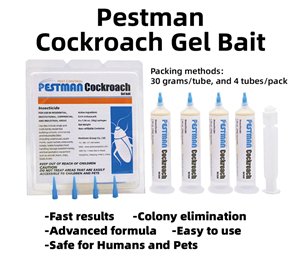
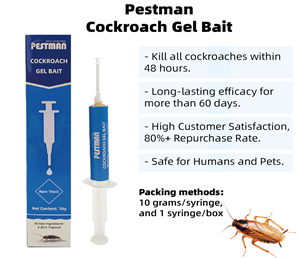
Among cockroach bait manufacturers, Pestman has established a reputation for reliability through long-term investment in pest control technology.
The company focuses on:
attractant-based formulation research
stable manufacturing processes
global distribution support
Key strengths include:
Attractant technology
Pestman cockroach gel bait formulations incorporate multiple pheromone components designed to enhance feeding behavior.
How to Choose a Cockroach Gel B…
International export experience
The company has delivered pest control products to more than 50 countries worldwide.
Before selecting a cockroach gel bait manufacturer, buyers should evaluate the following factors:
Product effectiveness
Does the bait contain advanced attractant systems?
Research capability
Does the manufacturer invest in formulation R&D?
Manufacturing stability
Are production processes standardized?
Export experience
Does the company ship products internationally?
Regulatory support
Can the supplier assist with product registration?
Customization
Are OEM and private-label services available?
Frequently Asked Questions (FAQ)
1. What determines cockroach gel bait effectiveness?
The most important factor is the attractant system, which determines whether cockroaches consume the bait.
2. Why do some cockroach baits fail?
Cockroaches may ignore the bait if the attractant is weak.
3. Are pheromones necessary in cockroach bait?
Pheromones significantly increase feeding behavior and colony recruitment.
4. Why is field testing important?
Laboratory results may not reflect real-world environments with competing food sources.
5. Who typically purchases cockroach gel bait in bulk?
Common buyers include:
pest control companies
distributors
importers
retailers
e-commerce brands
6. Can cockroach bait products be customized?
Yes. Many manufacturers provide OEM and private-label production.
7. Do suppliers help with regulatory approval?
Some manufacturers provide registration support and Free Sale Certificates.
8. How can buyers avoid unreliable suppliers?
Buyers should evaluate attractant technology, research capability, export experience, and product performance.
Author
Eurek Chen: The Scientist Bridging Lab and Market in Global Pest Control
In the intricate world of global pest management, where efficacy must meet safety and innovation is constantly challenged by regulation, one expert operates at the unique intersection of deep science and international commerce. Eurek Chen, a specialist in the pest control product trade, is not a conventional sales strategist. His authority is rooted in a research laboratory at one of China’s most prestigious universities.
An Academic Foundation in Urban Entomology Mr. Chen’s professional journey began at the Urban Entomology Research Center of Zhejiang University, a leading institution in China for the study of integrated pest management (IPM) in human habitats. It was here that he was immersed in rigorous, state-level research, developing a foundational expertise in insect biology, ecology, and the practical mechanics of pest control. This experience forged a mindset that views every pest challenge first through a scientific lens, a discipline that continues to define his approach to the global market.
Directing Research Towards Future Frontiers Now, Chen focuses his expertise on three interconnected domains that signal the future direction of the pest control industry:
1. Advanced IPM for Modern Cities: His work in urban entomology is dedicated to deciphering the adaptive behaviours of pests—from cockroaches and termites to stored-product insects—in our increasingly dense cities. The goal is to develop sophisticated, location-specific IPM strategies. These strategies prioritise monitoring and prevention, employing a combination of tactics to achieve sustainable control and reduce reliance on blanket chemical applications.
2. The Science of Insect Behaviour and Toxicology: While well-versed in the mode of action and resistance management of insecticides, Chen’s research delves into the more nuanced realm of behavioural manipulation. He investigates next-generation insect attractants (like pheromones) and repellents. The aim is to develop precise tools that can monitor, trap, or repel target pests by interfering with their fundamental behaviours, offering a more targeted and environmentally conscious approach to population control.
3. An Unconventional Energy Quest: The Termite Bioreactor: Perhaps his most pioneering line of inquiry involves turning a major pest into a potential resource. Chen’s research explores the remarkable efficiency of termite gut microbes, which can break down woody biomass. He is investigating the potential to harness or mimic this natural system to convert agricultural waste into renewable biofuels, such as bioethanol. This cross-disciplinary work represents a radical shift in perspective, viewing pests not just as problems to be eliminated, but as models for innovative biotechnological solutions to global energy challenges.
From Laboratory Insights to Global Solutions Leveraging this scientific acumen, Eurek Chen operates in the international arena of pest control product sourcing and development. He acts as a crucial interpreter between complex research and market-ready products. For manufacturers, distributors, and large-scale pest control service corporations worldwide, he provides more than just product specifications; he offers evidence-based analysis, technical consultancy, and insights into evolving regulatory landscapes, ensuring that solutions are not only effective but also scientifically sound and sustainable.
A Vision for Informed Pest Management Eurek Chen champions a vision for the industry where management decisions are driven by data and ecological understanding. He advocates for a transition from reactive extermination to proactive, science-based stewardship. His mission is to ensure that the most advanced research in entomology and toxicology is translated into practical, reliable tools that safeguard public health and food security worldwide, while fostering a more balanced coexistence with the ecosystems we share.